Ultrametric laser-based two-wire welding robot - delving into automotive chassis manufacturing: why is high-strength welding inseparable from two-wire welding robots?
发布日期:2026-04-02 浏览量:1
Technical answer: How to weld structural components of automobile chassis
Today, let's talk about the welding methods for automotive chassis structural components, such as subframes, control arms, and torsion beams. The mainstream process nowadays is indeed "robotic spot welding". However, depending on different materials and varying requirements for precision and strength, it is generally subdivided into the following two main processes.
Robot MAG welding (the most common type of MIG welding)
This is the most common "CO₂ welding" we usually refer to. The shielding gas used is either 80% argon (Ar) mixed with 20% carbon dioxide (CO₂, this is an argon-enriched gas mixture), or pure carbon dioxide.
This welding method has many advantages: it is not very expensive and has strong wind resistance. Even if there are some errors in the gap between parts during assembly, it can still be welded together, showing a high tolerance for such groove errors. Moreover, the welding penetration is relatively large, meaning it can weld deeper.
In practical applications, over 90% of the welding of steel structural components on the chassis utilizes this material. It is particularly suitable for welding steel pipes with considerable thickness, as well as when stamped parts are assembled and welded together.
Why choose a super-meter laser-based second-level maintenance welding robot for automotive chassis
1. Save costs and lower thresholds, anyone can do it
A general worker can be trained to get started in just half a day, eliminating the need to maintain expensive experienced workers. The robots weld quickly and steadily, with one person able to oversee two or three machines, directly reducing labor costs by more than 30%.
On-site welding of automobile chassis by a two-wire welding robot
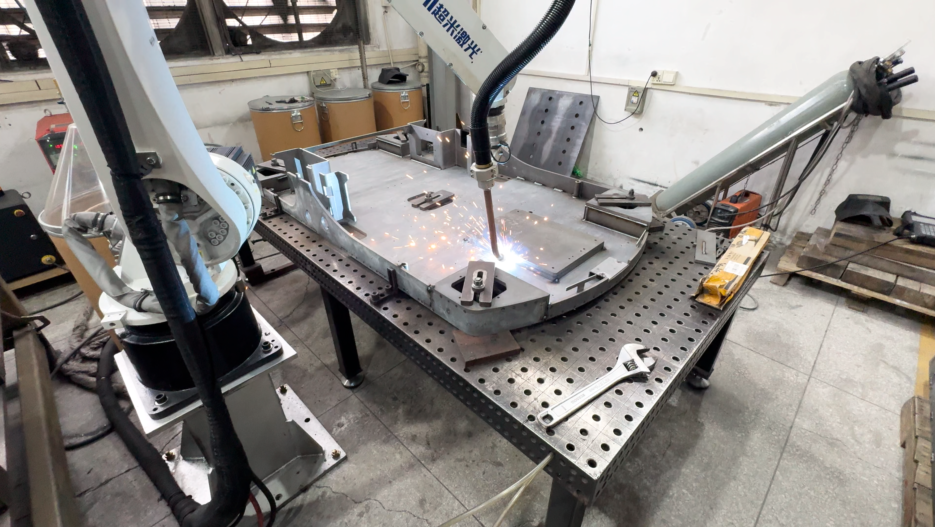
2. Maximize efficiency and ensure high precision
This thing can work non-stop for 24 hours, with an efficiency at least 40% higher than manual labor. The six-axis articulated arm is incredibly flexible, with a repeatability accuracy of ±0.05mm. It can smoothly navigate even the trickiest angles of welding seams, achieving a consistency that manual labor cannot match.
3. Durable and reliable, worry-free to use
The protection level reaches IP67, ensuring that dust and oil stains do not significantly hinder operation. The machine body is made of high-strength aluminum alloy, providing good rigidity and portability. Coupled with the RV reducer system, it is durable, low in noise, and easy to maintain.
4. Simple operation and low threshold
Visual drag-and-drop programming is like playing with a large "figure", where you can drag and solder wherever you like. It also supports offline programming, ensuring no production delays. Coupled with intelligent sensors for real-time monitoring of welding quality, any issues can be detected promptly, eliminating the need for 24-hour monitoring.
5. Strong industry applicability
From automotive chassis and steel structures to metal furniture, stainless steel, carbon steel, and galvanized sheets can all be welded. Especially for load-bearing components such as automotive chassis, the penetration depth of CO2 welding is sufficient, and the strength is guaranteed. It also allows for dual-station switching, reducing clamping time by half.
On-site welding of automobile chassis by ultra-high-precision robotic welding machine
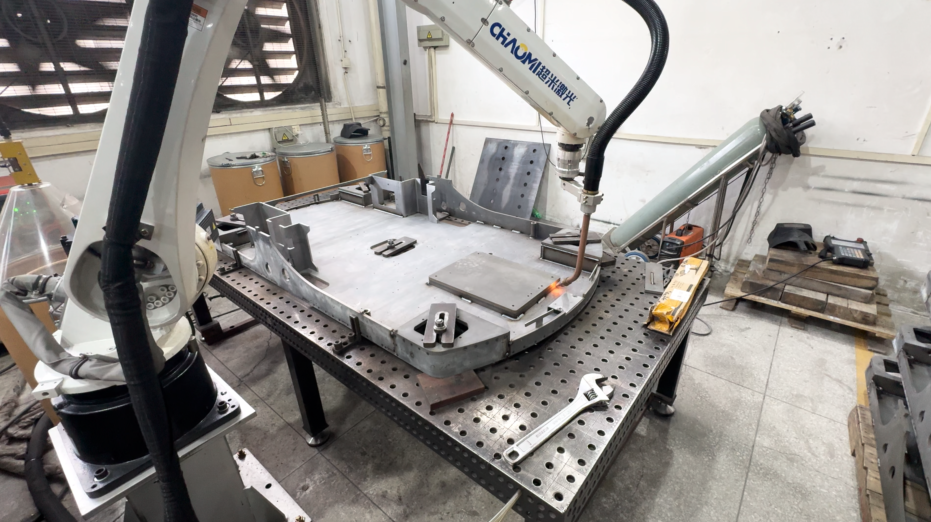
6. Alleviate the difficulty in recruiting workers
The difficulty in recruiting and retaining welders is a common problem in the industry. Robots can directly solve this issue. With standardized operations, there is no need to worry about poor welding quality due to the mood of experienced welders, nor is there any concern about personnel turnover affecting production capacity.
In a nutshell:
The Chaomi two-maintenance welding robot saves money, manpower, and worry - with an efficiency increase of 40%, a yield rate of 99.6%, low operational thresholds, and high protection levels. When it comes to tasks like chassis welding, it is fast and stable.
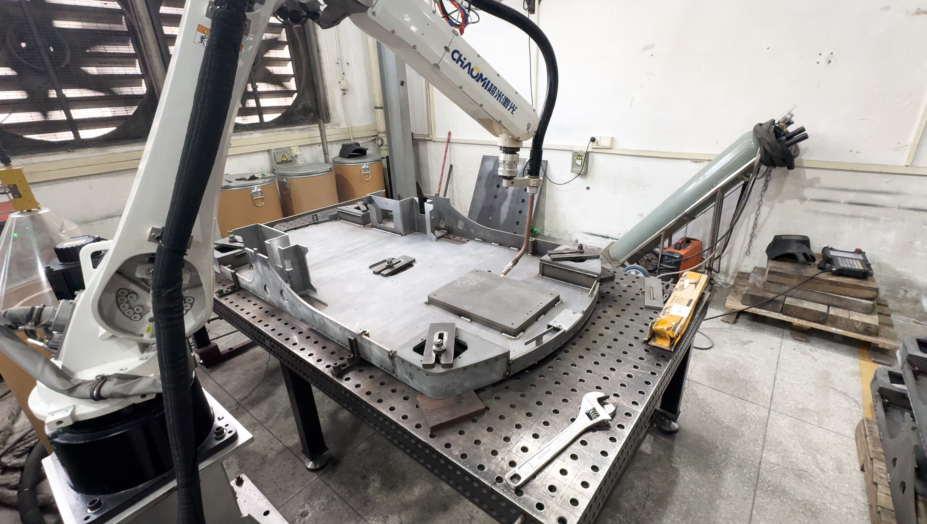
Our solution is already quite mature in the industry. You can first visit our client's site to see the actual welding results. The parameters can be adjusted according to your product, and we guarantee your satisfaction. You can contact Chaomi Laser for more case videos
On-site welding of automobile chassis by a robotic arm using CO2 welding
Robot MIG welding (suitable for welding of special materials)
It generally uses pure argon or a mixed gas with a relatively high argon content.
Where is this welding method mainly used? If the chassis structural components are made of aluminum alloy, such as all-aluminum subframes, it is commonly used for welding. Additionally, robotic MIG welding is also suitable for galvanized sheets that require particularly high surface quality.
Laser-MAG hybrid welding (a new choice for high-end vehicles)
Nowadays, some high-end vehicle models, or those with chassis made of high-strength steel, have started to adopt the new method of "laser + MAG hybrid welding".
What are its benefits? The welding speed is incredibly fast, whoosh! And it generates less heat during welding, resulting in minimal thermal deformation. Plus, it can weld on one side, but both sides look well-formed after welding.